The IMF has revised its global growth forecast upward, projecting world GDP to expand by 3.0% year-over-year in 2025, up from 2.8% in the April edition of the World Economic Outlook. For 2026, growth is now anticipated at 3.1%, modestly higher than the prior estimate of 3.0%. Nonetheless, these figures remain well below the pre-pandemic trend of approximately 3.7%, reflecting the enduring effects of trade disruptions, tighter monetary policy, and unrestrained fiscal expansion. The IMF further warns that under a scenario of maximum tariff implementation, global output in 2026 could be 0.3 percentage points lower.
The recalibration in growth expectations reflects a complex blend of reactive trade dynamics and persistent macroeconomic risks. On the trade front, the IMF highlights a global acceleration in import activity, as firms seek to front-load shipments ahead of scheduled U.S. tariff increases. Moreover, recent bilateral trade agreements have helped temper the tariff outlook, with the EU and Japan securing 15% tariff rates, the U.K. at 10%, and Southeast Asian economies—including Indonesia, the Philippines, and Vietnam—at 20%. However, downside risks remain acute, most notably the uncertainty surrounding the U.S.-China trade relationship, which anchors a significant portion of global trade flows. Added to this are ongoing geopolitical tensions and a widening fiscal deficit landscape, both of which continue to cast a shadow over the medium-term outlook.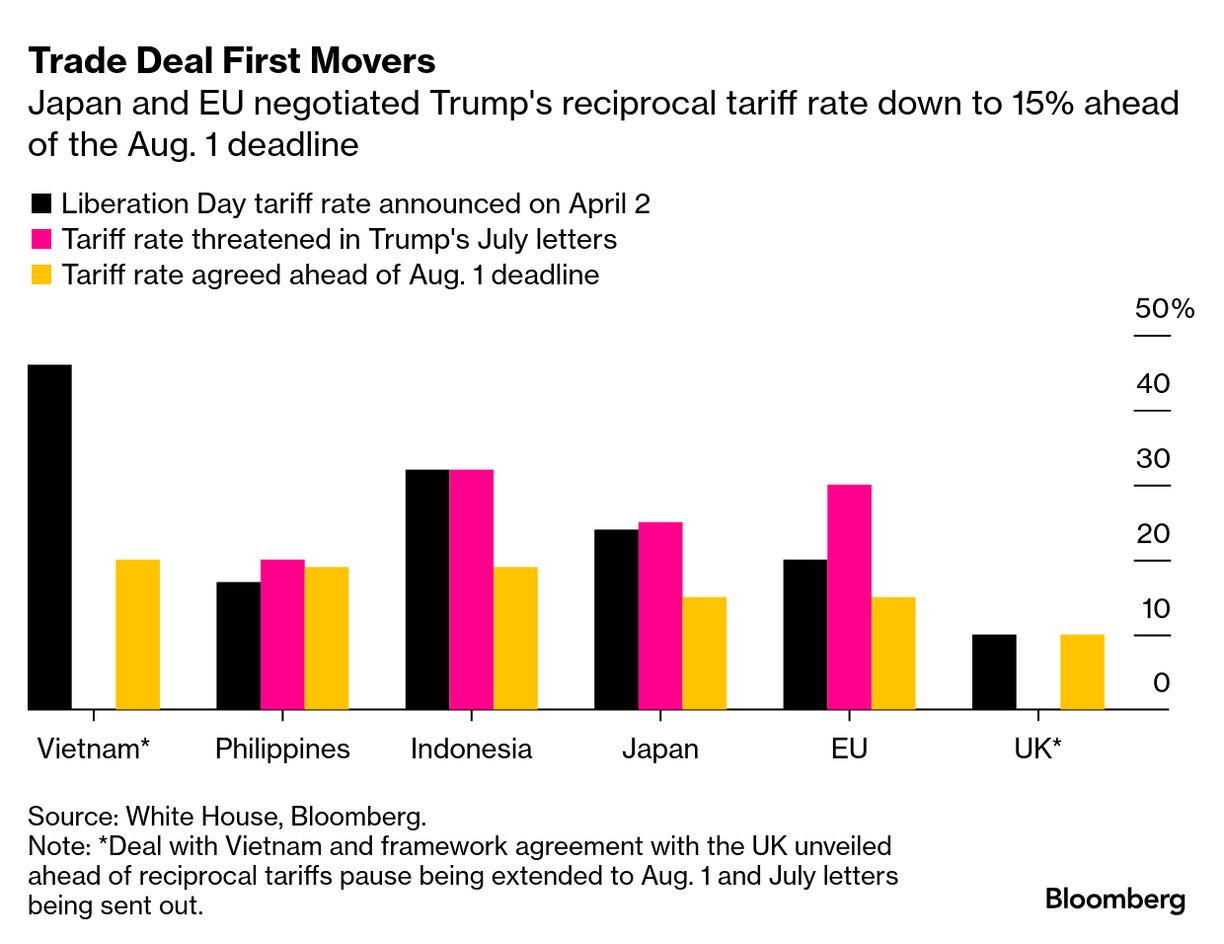
At the regional level, the IMF upgraded the U.S. growth forecast to 1.9% in 2025 and 2.0% in 2026, supported primarily by the stimulative effects of recent tax reforms. However, core inflation is expected to remain above the Federal Reserve’s 2% target, complicating the monetary policy trajectory. China’s GDP forecast was raised to 4.8% in 2025, reflecting milder-than-expected tariff impacts and sizable fiscal stimulus. In the Euro Area, the growth projection for 2025 now stands at approximately 1.0%, with pharmaceutical exports—particularly from Ireland—acting as a key growth anchor. However, potential retaliatory tariffs on pharmaceutical products exported to the U.S. introduce notable downside risks. Emerging Markets and Developing Economies (EMDEs) are projected to grow by 4.1% in 2025, while Japan’s 2026 growth was revised downward to 0.4% from 0.5%, amid expectations of tighter financial conditions. This drag is expected to be partially offset by benefits accruing from Japan’s 15% trade deal with the U.S.
Looking ahead, the IMF emphasizes the critical importance of preserving central bank independence. Any erosion in monetary policy autonomy—particularly under political influence—could undermine policy credibility, risk a resurgence in inflation, and destabilize financial markets. In tandem, the Fund warns that rising fiscal deficits in advanced economies may weaken investor confidence in reserve currencies and global safe assets, injecting further volatility into the macroeconomic environment.
Written by Michael Ogunremi
Credit – Reuters, Times UK, AP News, IMF, Bloomberg
Image Credit – iStock
